
Sleeping Bag Temperature Ratings: What Wholesale Buyers Should Verify

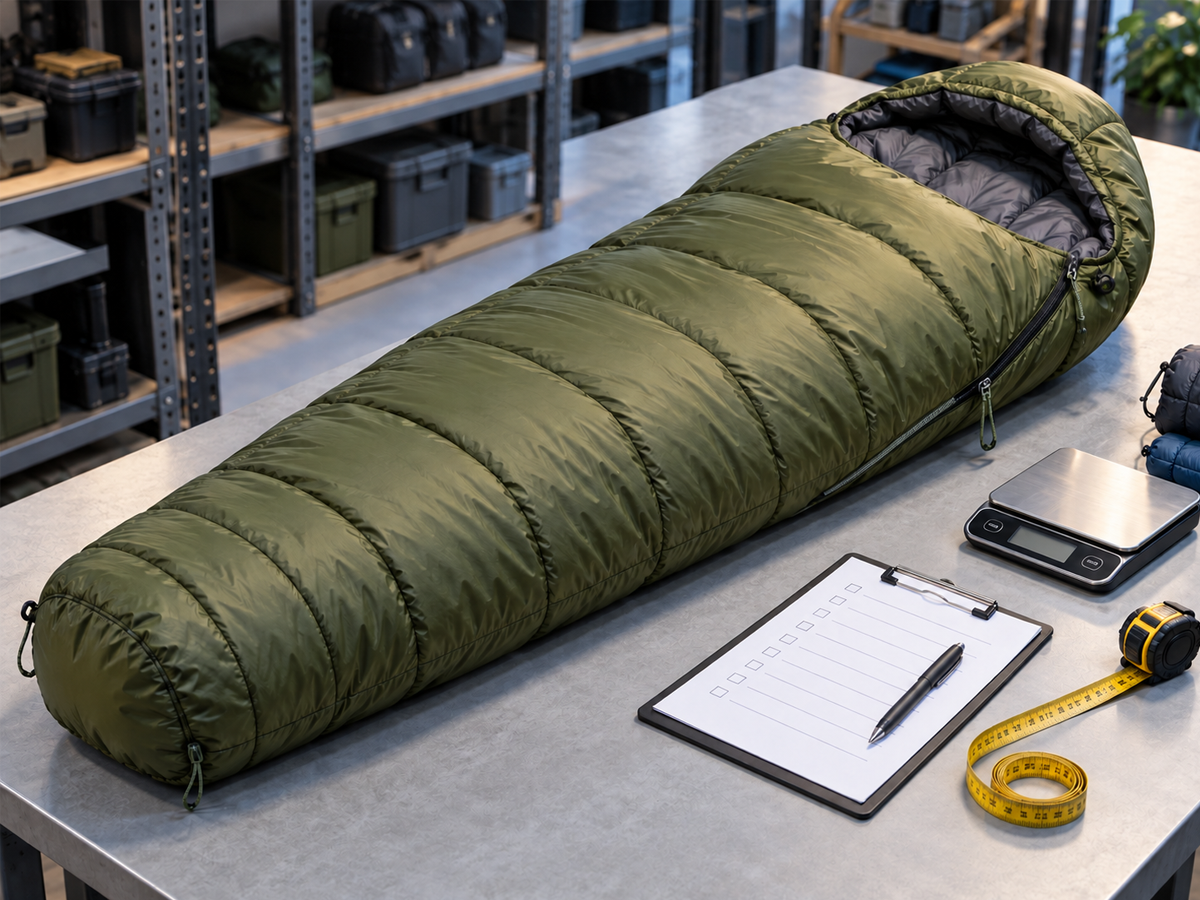
Wholesale buyers should verify the rating type, test method, report identity, and tested specifications before approving a sleeping bag’s temperature claim.
A sleeping bag described as “−5°C” can create confusion before a purchase order is signed. Does that figure mean Comfort, Limit, or Extreme? Was the finished sleeping bag tested, or was the number estimated from its filling weight?
For outdoor brands, importers, and distributors, these questions affect product selection, pricing, customer expectations, and after-sales support. A temperature printed on a hangtag needs supporting evidence that connects it to the product being supplied.
This guide explains how to verify sleeping bag temperature ratings, what costs and specifications to compare, and how to manage risks across multiple models.
What Do Comfort, Limit, and Extreme Mean?
Sleeping bag temperature ratings describe different reference conditions. Buyers should identify which rating appears in the product name, quotation, specification sheet, and retail description.
| Temperature Rating | Meaning | What Wholesale Buyers Should Check |
|---|---|---|
| Comfort | A reference temperature for a standard female sleeper resting comfortably in a relaxed position under standardized conditions. | Whether the Comfort rating supports the intended use and product positioning. |
| Limit | A lower reference temperature for a standard male sleeper maintaining thermal balance in a curled position under standardized conditions. | Whether Limit is clearly distinguished from Comfort. |
| Extreme | An emergency reference associated with serious cold-related risks. | Whether it is clearly separated from normal sleeping recommendations. |
These ratings use standardized models and conditions. They cannot guarantee that every customer will feel comfortable at the stated temperature.
For wholesale comparisons, place Comfort beside Comfort and Limit beside Limit. Comparing one supplier’s Comfort figure with another supplier’s Extreme figure can make substantially different products appear equivalent.
The phrase “3-season sleeping bag” also needs clarification. It describes a product category but does not establish one universal temperature range. Our 3-season vs winter sleeping bag guide explains the broader differences between these categories.
How To: Verify Sleeping Bag Temperature Claims Before Ordering
1. Define the Intended Use
Start with the customer and expected conditions.
A sleeping bag for campsite holidays has a different brief from one intended for cold-weather trekking. Specify the target market, user group, expected overnight conditions, weight requirements, and intended sleeping system.
State your requirement using a named rating, such as “target Comfort temperature,” rather than asking only for a “−5°C sleeping bag.”
This gives suppliers a clearer basis for recommending materials and construction. For a broader product-selection framework, read our sleeping bag buying guide.
2. Identify the Test Standard and Its Scope
Ask the supplier for the full standard designation and edition used in the report.
ISO 23537-1:2022 addresses thermal, mass, and dimensional requirements for adult-sized sports and leisure sleeping bags designed for Limit temperatures of −20°C and higher.
Check whether the product falls within that scope. Children’s products, unusual constructions, and products outside the stated temperature scope need separate consideration. Ask the laboratory how performance should be assessed and communicated.
A statement such as “ISO tested” does not identify the test performed, the standard edition, or the product evaluated.
3. Request the Relevant Test Report
Obtain the report rather than relying on a screenshot of a temperature table.
Check the laboratory name, report number, issue date, applicant, sample identification, test method, and results. Review photographs and notes that help identify the tested sample.
If information is unclear, request clarification or seek verification through the laboratory’s available process.
A report for another product or a raw material does not establish the finished sleeping bag’s temperature rating. The evidence should identify the sleeping bag configuration being evaluated.
4. Match the Tested Sample to the Order
Compare the tested sample with the proposed purchase specification.
| Item to Verify | What to Compare |
|---|---|
| Model identity | Model number, product name, and revision |
| Size | Length, shoulder width, foot width, and relevant internal dimensions |
| Insulation | Filling type, specification, and quantity |
| Construction | Insulation distribution, baffles, seams, and layer arrangement |
| Fabrics | Shell and lining materials |
| Heat-retention features | Hood, draft collar, zipper, and draft tube |
Ask the supplier to explain differences in writing.
A larger size or revised construction should not automatically inherit an existing result. Where differences could affect performance, obtain a technical assessment and determine whether additional testing is needed.
5. Separate Tested Results From Estimates
A development estimate can help compare early concepts, but its status should remain clear.
Ask whether the quoted figure comes from a finished-product test, an assessment based on another model, or an internal estimate. Request the supporting basis.
Avoid allowing a development target to become a “tested” retail claim during label preparation.
Before approving packaging, confirm the wording that the evidence supports. Keep this wording consistent across quotations, specification sheets, hangtags, and online product descriptions.
6. Approve a Production Reference
Keep an approved pre-production sample with the final specification sheet.
Record filling quantities, dimensions, materials, construction details, and agreed tolerances. Establish a process for approving substitutions or design changes.
During production, inspect these characteristics for consistency. Filling-weight checks and workmanship inspections support production control, but they do not independently establish a temperature rating.
Where further thermal verification is necessary, agree on sampling and testing before production begins.
How Much: What Specifications and Costs Should Buyers Compare?
Compare Complete Specifications
Consider temperature performance alongside weight, packed size, construction, and price.
The following figures are hypothetical examples, not TRAILVO product specifications.
| Parameter | Example A | Example B |
|---|---|---|
| Comfort temperature | +5°C | 0°C |
| Limit temperature | 0°C | −5°C |
| Insulation type | Synthetic | Synthetic |
| Total weight | 1,200 g | 1,550 g |
| Packed volume | 10 L | 14 L |
A buyer targeting lightweight travel may make a different decision from a retailer targeting cooler campsite conditions.
The temperature difference alone cannot explain the full commercial value. Compare products against the same customer brief and confirm that the figures have comparable supporting evidence.
Filling weight, fabric denier, and down fill power are useful specifications, but none provides a universal formula for calculating a finished sleeping bag’s temperature rating.
Budget for Verification
Request a project-specific laboratory quotation.
| Cost or Timing Item | Question to Ask |
|---|---|
| Testing scope | Which method, measurements, and report deliverables are included? |
| Samples | How many samples are required, and who provides them? |
| Preparation and shipping | Are preparation, conditioning, and transport included? |
| Turnaround | When does the testing period begin? |
| Additional work | What happens if further assessment or retesting is needed? |
| Payment responsibility | Who pays for initial testing and testing after revisions? |
Confirm whether testing is included in the supplier’s development quotation or invoiced separately.
These details belong in the development budget before retail pricing and launch dates are finalized. Comparing quotations is easier when each supplier clearly separates product costs from development and verification costs.
Allow Time for Design Changes
A project targeting a particular Comfort temperature may require adjustments after sample evaluation.
Changes can involve filling quantity, insulation distribution, dimensions, or construction. They may also affect total weight, packed volume, unit price, and delivery timing.
Ask the supplier to show these effects together.
Avoid committing to printed temperature claims while the design and supporting evidence are still being finalized. Revising packaging after approval can create additional cost and delay.
Use One Purchasing Comparison Sheet
Keep technical evidence and commercial terms in the same comparison document.
| Category | Information to Record |
|---|---|
| Thermal claim | Comfort, Limit, Extreme, and temperature units |
| Supporting evidence | Standard, laboratory, report number, and date |
| Product identity | Model, size, revision, and filling specification |
| Commercial terms | Unit price, MOQ, testing fees, and lead time |
| Approval status | Tested, awaiting verification, or development target |
This makes missing information visible before price becomes the main basis for supplier selection.
How Many: Manage Model Coverage, Order Scale, and Risk
How Many Models Need Review?
Review every distinct product configuration before assigning a temperature claim.
For example, three insulation options offered in two sizes create six configurations to assess. This does not automatically mean six separate tests are required. It means evidence coverage must be considered for all six.
Ask the laboratory or qualified technical reviewer whether results can support related configurations, and record the reasoning.
Do not extend one report across a collection simply because the products share a name or appearance.
How Many Production Units Should Be Checked?
There is no single inspection quantity suitable for every order.
Agree on the production lot, sampling plan, inspection level, defect definitions, and acceptance criteria. Give additional attention to new materials, unfamiliar production processes, or previous inconsistencies.
Checks may include filling weight, dimensions, construction, and labeling.
A finished-goods inspection evaluates sampled characteristics. It should not be presented as proof that every unit has been thermally tested.
How Much Production Variation Is Acceptable?
Set measurable tolerances before production.
Filling quantity, dimensions, and other specified characteristics should have agreed limits and measurement methods. If the factory proposes a tolerance, ask how it was established and how deviations will be handled.
There is no universal rule that a given percentage change in filling produces an equivalent percentage change in warmth.
Material deviations from the approved configuration require review before retaining the original temperature claim.
What Can Go Wrong After Launch?
Unclear ratings can lead customers to expect comfortable sleep at a temperature intended as a Limit or Extreme reference.
Other risks include mismatched reports, inconsistent descriptions, and unapproved material substitutions.
| Risk | Recommended Buyer Action |
|---|---|
| A temperature appears without its rating type | Specify Comfort, Limit, or Extreme beside the figure. |
| The report describes a different model | Request matching evidence or a documented technical assessment. |
| Materials change after sample approval | Review the change before retaining the claim. |
| Retail channels show different ratings | Check product pages, packaging, hangtags, and dealer information together. |
| Customers expect identical real-world results | Explain relevant sleeping conditions and individual variation. |
Customer guidance should explain that sleeping-mat insulation, clothing, moisture, weather, and individual cold sensitivity influence actual experience.
Frequently Asked Questions
Is a −5°C Sleeping Bag Comfortable at −5°C?
The number alone is insufficient. Establish whether −5°C refers to Comfort, Limit, or Extreme, then review the supporting evidence and intended conditions.
Can Filling Weight Prove a Temperature Rating?
Filling weight helps define the product, but finished performance also depends on materials, dimensions, insulation distribution, and construction. It cannot independently prove a temperature rating.
Can One Report Cover Every Size?
Coverage needs assessment. Size changes may affect performance, so request a documented technical basis rather than assuming every size shares one result.
What Should Wholesale Buyers Request First?
Request the complete product specification, named temperature ratings, relevant report, tested-sample identity, and an explanation of differences from the proposed order.
Discuss Your Sleeping Bag Project With TRAILVO
Explore our wholesale sleeping bag range to identify potential starting designs for your project.
Send us your target market, intended user, target Comfort temperature, preferred insulation, sizes, and estimated order quantity.
Contact TRAILVO to discuss the proposed configuration, available supporting documents, and verification needed before approving your product specifications and temperature claims.